Guide · consumer units
The fuse board, and when it has had its day.
426 board changes in, the questions are always the same ones. Here is what a modern consumer unit does that an old fuse board does not, how to tell whether yours needs doing, and what the day itself looks like — so you can judge the quote you have been given rather than take it on trust.
Six signs it is due
0101
Rewireable fuses or cartridge fuses
A board with fuse wire in it predates almost every protective device we now take for granted. It is not automatically dangerous, but it offers no protection against an electric shock from a damaged cable.
02
One RCD covering half the house
Older split-load boards put six or eight circuits behind a single RCD. One faulty appliance in the kitchen takes out the lights, the freezer and the alarm — usually while you are away.
03
A plastic board under the stairs or in a communal area
Since 2016 the regulations have called for non-combustible enclosures in domestic premises. In a block, a plastic board on an escape route is one of the first things an inspector looks at.
04
No spare ways
A board that is physically full ends the conversation about a shower circuit, an EV charge point or a garden supply before it starts.
05
C2 observations about protection on your EICR
If the report flags inadequate additional protection across several circuits, replacing the board is usually the cheaper answer to the whole list.
06
Scorch marks, buzzing, or a warm board
Stop reading and ring somebody. Heat and noise at a board mean a loose or failing connection, which is a fire risk rather than an inconvenience.
02 · the day itself
Out, in, tested, labelled.
- Before anything is disturbed — the existing circuits are tested so there is a record of what was already wrong. Old faults do not become new ones on somebody else's invoice.
- Board out, board in — a metal enclosure, each circuit on its own RCBO, surge protection assessed for the property, cables re-dressed properly rather than bundled back behind the cover.
- Earthing and bonding put right — the main earthing conductor and bonding to gas and water checked and upgraded where they fall short. This is the bit that quietly fails condition reports.
- Tested and written up — every circuit retested, results recorded, certificate issued, every way labelled for whoever opens it next.
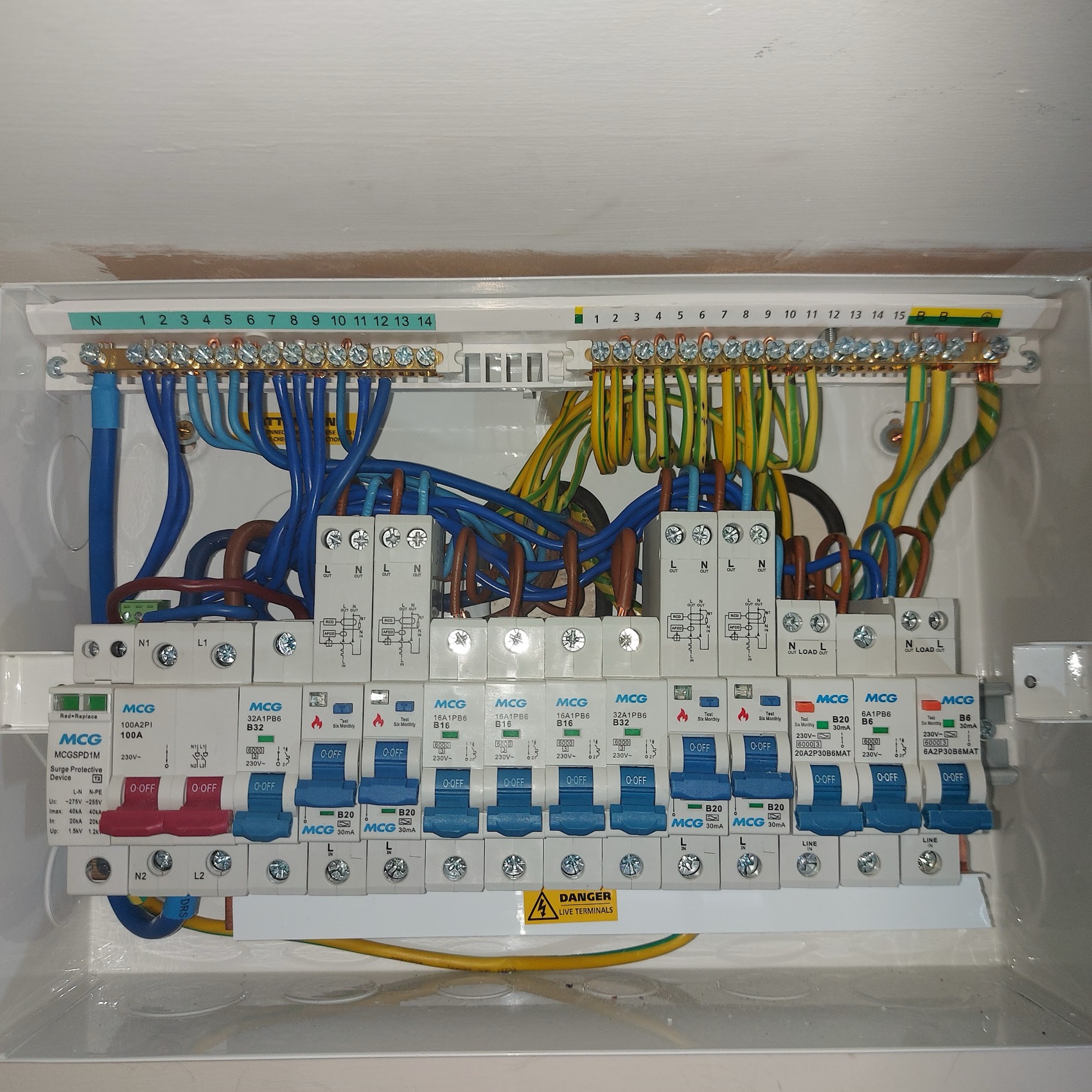
One of Rick's own boards, mid-install
Consumer unit FAQ
03RCD or RCBO — what is the difference?
An RCD detects current leaking to earth and disconnects. An RCBO does that for a single circuit and provides the overload and short-circuit protection of a breaker as well. A board of RCBOs means a fault on one circuit only ever kills that circuit — which is why modern boards are built that way and why it matters far more in a let property than people expect.
What is a surge protection device, and do I need one?
An SPD clamps voltage spikes — lightning-induced transients, switching surges — before they reach your electronics. The current regulations require the risk to be assessed rather than blanket-fitted, so the honest answer is: it gets considered when the board goes in, you get told whether this property warrants one, and you decide.
Why does the earthing and bonding keep coming up?
Because it is the bit nobody can see. Main protective bonding to incoming gas and water services, and the earthing arrangement itself, are what make every protective device in the board work as intended. They are checked and put right at the same visit — a new board on top of inadequate bonding is decoration.
How long does a board change take, and will the power be off?
Most domestic changes are a day, with the supply off for a good part of it. Circuits are tested before the new board goes in and again afterwards, which is the slow part and also the part that matters. If you work from home, plan for a day elsewhere.
Do I get paperwork?
Yes — an Electrical Installation Certificate for the work, with the schedule of test results, and the board itself labelled with what each way feeds and the date of the next recommended inspection. If you are a landlord, keep it with the EICR; the next inspector will ask.
Does a new board mean my whole house is compliant?
No, and be wary of anyone who says it does. The board protects the installation; it does not fix undersized cabling, missing earths in old lighting circuits or a bathroom wired before the zones existed. A condition report tells you what is actually there.